
Peel THE Potato Diamonds Guide: How to Get Diamonds and What They're Used For
How to get Diamonds in Peel THE Potato: they appear as finds inside the round's potato mountain and the run-end tally credits them automatically — one documented run earned 66. What Diamonds are spent on can't currently be verified, and this guide explains exactly why.
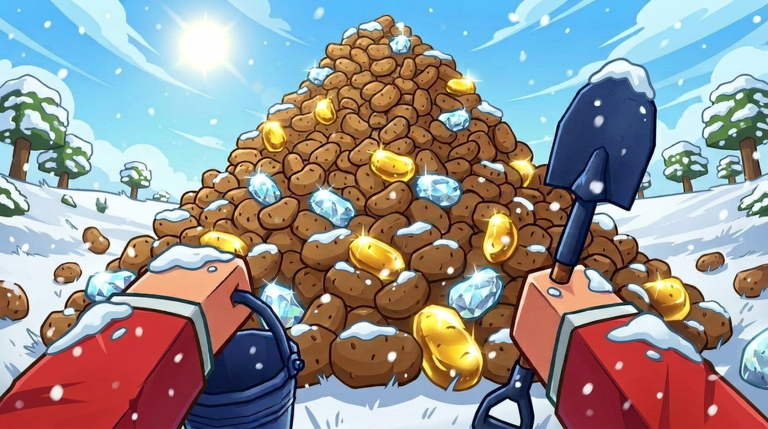
Diamonds in Peel THE Potato are a find-and-tally currency: they show up as finds inside the round's potato mountain while you peel through it, and the end-of-round tally credits them to you automatically — no hand-in, no claim button. One complete documented playthrough ended with the tally reading "I only earned 66 diamonds."
What you can spend them on is the part that isn't settled. In that same full run, not a single Diamond was spent, and the game's sampled store catalog lists no Diamond item at all. So the honest current answer is: Diamonds are earned through normal play, and no use for them can be verified yet. Here's how the earning loop works, what each currency in your run actually is, and exactly where the evidence stops.
What Diamonds are in the current game
A round of Peel THE Potato puts several kinds of money in front of you, and they don't do the same job:
| Currency | Where it comes from | What documented play shows it buying |
|---|---|---|
| In-round cash ($) | Accumulates while you work the round ("Almost at $20") | Tools and upgrades — the shovel, the potato vacuum ("The potato vacuum looks like it's $30"), peeling-machine upgrades |
| Gems | Mentioned as a free grant alongside starter-class rerolls ("the free gems that it gave me") | Starter-class rerolls in the documented session; the store also sells Gem amounts for Robux |
| Diamonds | Finds inside the potato pile while you peel; totaled in the run-end tally | Nothing observed |
| Robux | Real money | Auto-peel access ("the auto peel, but that's Robux") and the store catalog's passes and boosts |
One relationship is deliberately left open: no source clarifies whether Gems and Diamonds are one currency or two. The run tally counts 66 diamonds, while the same line mentions "They gave me 100 for free" — and which of the two that 100 refers to isn't established. The store's paid items are all Gem-denominated, so treat Gems and Diamonds as separate and don't buy Gem packs as a Diamond shortcut.
How to get Diamonds
The documented run grounds a complete, repeatable loop:
- Join a round and start clearing the potato mountain. Diamonds come from the pile itself, not a separate activity — if you're new to the loop, the beginner guide and the peeling guide cover the core clearing work, and the potato mountain guide breaks down the pile.
- Peel through the pile and watch for finds. In the documented run, a diamond counter appeared partway up the mountain — the player himself wasn't sure what triggered it: "I'm not sure why I have diamonds showing up now at 25%." Finds then continued while he fed the peeling machine ("Oh, I'm finding diamonds now") and were still appearing late in the run ("there's still some diamonds in there").
- Finish the round; the tally pays out automatically. Once the key was found in the pile and the player was sent back to the lobby, his haul was totaled at 66 diamonds. No claim or hand-in step appears anywhere in the run. If you're working on the key that ends the round, see the hidden key guide.
- Repeat next round. Finds continued for as long as any pile remained, and each round brings a fresh mountain, so the same clears-diamonds-tally loop earns again.
Two honest limits on that loop, from a single documented session: the exact per-find trigger isn't pinned down — a random find per potato cleared and a progress threshold are both consistent with what happened, and the narrator's own "25%" remark was a question, not a rule. And amounts aren't predictable: 66 diamonds from one full run is the only documented total so far.
What Diamonds are used for: what's actually verified
No Diamond use can currently be confirmed. That's not a hunch — it's the boundary of two concrete checks:
- A complete playthrough with zero Diamond spending. Every purchase in the run used in-round cash or Robux. The player never opened a Diamond-spending menu, never converted a Diamond, and never named one.
- A store catalog with no Diamond item. The catalog snapshot dated 10/4/2026 lists only Gem-denominated monetization — the "2x Gems" pass at 99 Robux, plus developer products "100 Gems 29 Robux", "250 Gems 49 Robux" and "999 Gems 139 Robux". No Diamond-priced or Diamond-granting product appears. (It's sampled public data, and prices and products can change between samples.)
What that can't prove: absence of an observed use in one run and one snapshot is not proof that Diamonds have no use. A shop or conversion could exist somewhere outside that session, or arrive in an update. So the practical guidance is simple — keep peeling and let the finds accumulate, don't spend Robux on Gem packs expecting Diamonds, and if a Diamond sink appears, it will show up via the updates feed. For freebies that are confirmed to exist, the codes page is the place to check.
What that means for your run
As documented, Diamonds behave as a run-result statistic: a record of what you found while clearing the pile, credited alongside your round time at the end. They didn't gate any tool, upgrade or access in the observed run — cash and Robux did that work. The documented session ran about 48 minutes with two players on one mountain, but that's context for the tally, not a benchmark to chase.
If your goal is faster rounds rather than a bigger find count, the timing resources are the actionable ones: start with the fastest escape time page or the full speedrun guide. And because both the earning details and any future Diamond uses are update-sensitive, recheck this page after major game changes — the catalog sample and the one-session earning evidence above both carry that caveat.
Related Guides
Potato Mountain: Landmarks and Route
A landmark-by-landmark tour of the mountain — pile, shop, machines, special potatoes, Vault — plus an efficient clear route.
Class Tier List (All 6 Classes)
All six classes ranked by roll rate and effect, with which class wins for solo money and group play.
Codes
Check currently usable codes and the verified redemption guidance for this game.